Does Night Light Actually Help You Sleep?
THE ANSWER
Probably not, and the reason is more interesting than a straight no. Blue light really does suppress melatonin. That mechanism is settled science. What is not settled is whether tinting your screen orange does anything about it. When researchers tested exactly that, melatonin suppression barely moved, and a week-long trial of 167 adults found no difference in how they slept with the feature on, off, or with no phone at all. The variables that hold up are how bright the light is, how long you sit in it, and when you stop. Color temperature is the one that gets all the attention and the least support.
This is a strange one to write, because half of it confirms what you have heard and half of it takes it apart. Almost every article on this subject picks a side and stays there. The evidence does not.
So this page goes in order: what blue light genuinely does to your body clock, what Night light and Night Shift actually change about the light leaving your screen, why those two facts do not connect the way the marketing implies, and what is left that is worth doing.
If you came here about eye strain rather than sleep, that is a different question with a different answer, and it lives on our dark mode guide. Short version: blue light is not what strains your eyes, and for reading, light mode measurably wins.
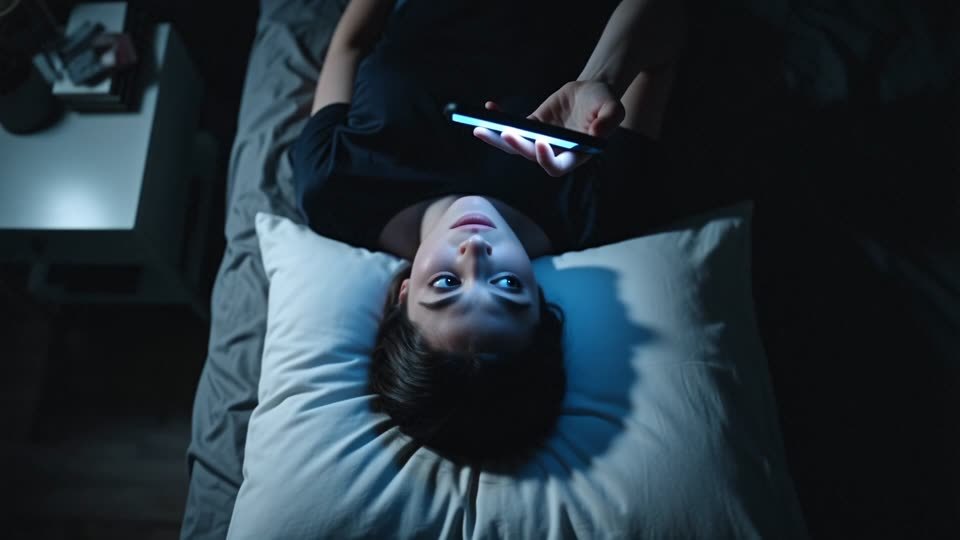
The part that is real: blue light moves your body clock
Your eye does two jobs. The familiar one is vision, run by rods and cones. The other was only pinned down in 2001, and it is the one that matters here.
Two teams working separately published action spectra that year, mapping which wavelengths of light suppress melatonin most effectively. Brainard and colleagues exposed 72 volunteers to eight single wavelengths in the middle of the night and found the response best fitted by a photopigment peaking at 464 nm (Journal of Neuroscience). Thapan, Arendt and Skene reached the same conclusion by a different route (Journal of Physiology): a photoreceptor system that is neither rod nor cone, tuned to short wavelengths.
That receptor turned out to be melanopsin, sitting in a small population of retinal ganglion cells that report ambient light level to the clock in your hypothalamus. It peaks in the blue. That is the entire reason anybody talks about blue light and sleep, and it is a genuine finding, not a wellness invention.
THE DISTINCTION THAT GETS LOST
Blue light affecting your sleep timing is well supported. Blue light damaging your eyes is not. These are two completely different claims that get bundled together, usually by someone selling a filter. The American Academy of Ophthalmology says there is no scientific evidence that light from computer screens damages the eyes. The circadian effect is real. The damage claim is not.
And screens at night do measurably shift it
The cleanest demonstration is still a 2015 study from Brigham and Women's Hospital. Twelve people lived in a sleep lab and read for about four hours before bed on five consecutive evenings, once from a light-emitting e-reader and once from a printed book. Compared with print, the e-reader condition delayed melatonin onset by more than an hour and a half (22:31 against 21:01), cut evening melatonin by roughly 55 percent, added about 10 minutes to how long people took to fall asleep, and left them with about 12 minutes less REM sleep and worse alertness the next morning (PNAS).
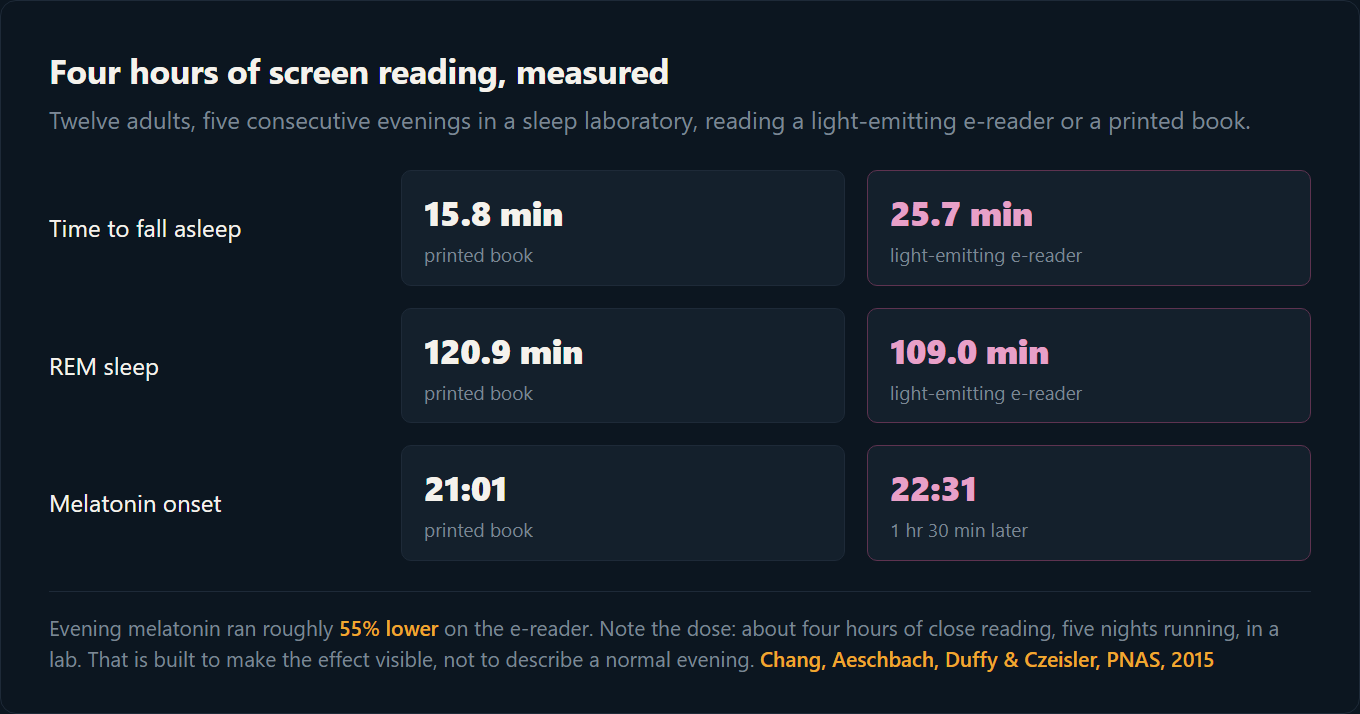
Read that dose carefully, because it is the part people skip. Four hours of close-range reading on a bright screen, five nights running, in a lab. That is a deliberately heavy exposure designed to make the effect visible. It is not a description of checking your phone for ten minutes. The effect is real; the size of it in your actual evening is smaller.
What Night light and Night Shift actually do
Both features do one thing: they shift the color temperature of the display toward amber. Cool white light contains a large short-wavelength component; warming it reduces that component's share and dims the total output somewhat. Nothing is filtered out completely, and nothing about the interface changes. A white page stays a page, it just goes orange.
In Windows 11 it lives at Settings › System › Display › Night light, and unlike dark mode it can schedule itself.
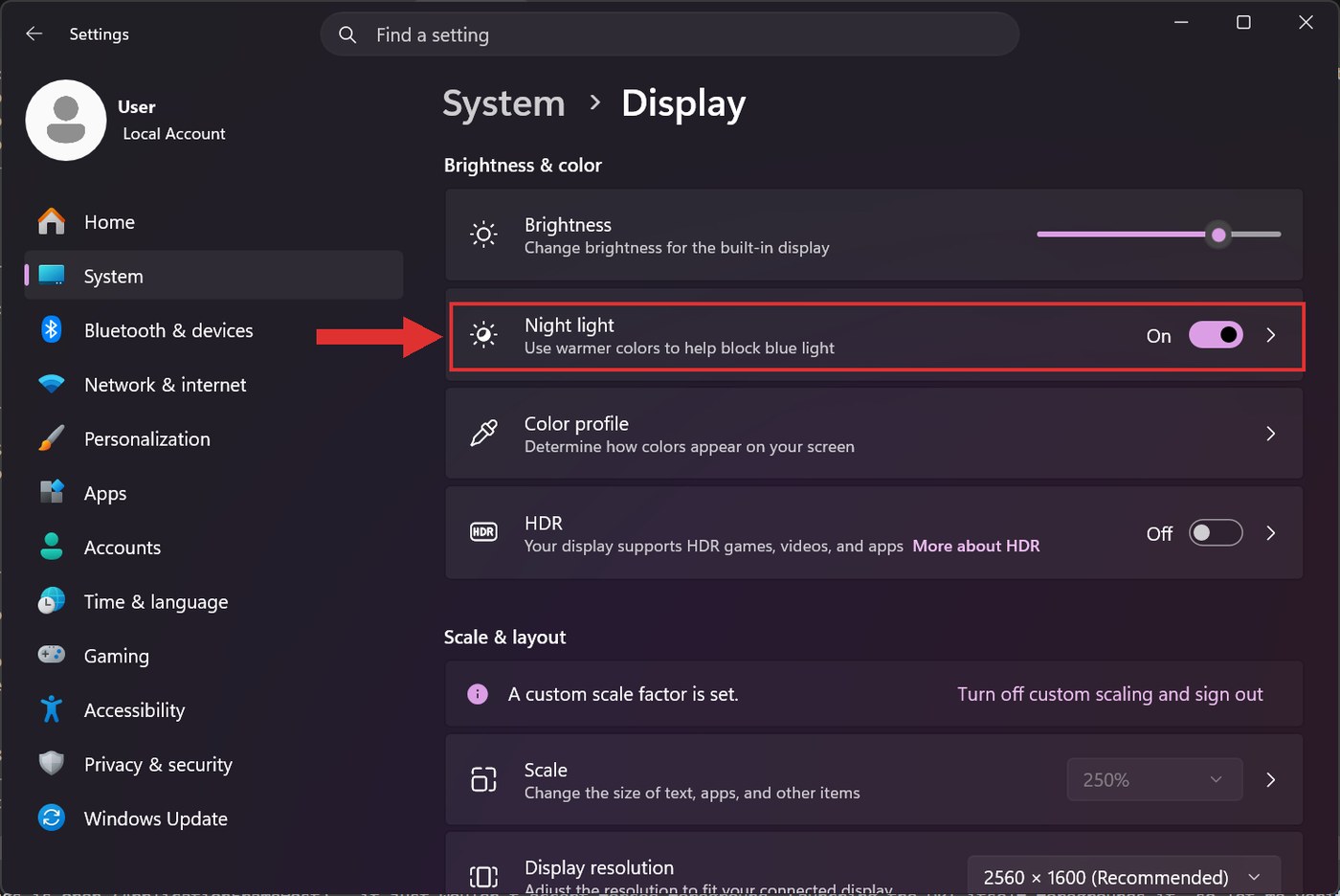
- Right click the desktop and choose Display settings
Night light is the first row on the page that opens. The toggle alone turns it on at the default strength.
- Click the row itself, not just the toggle
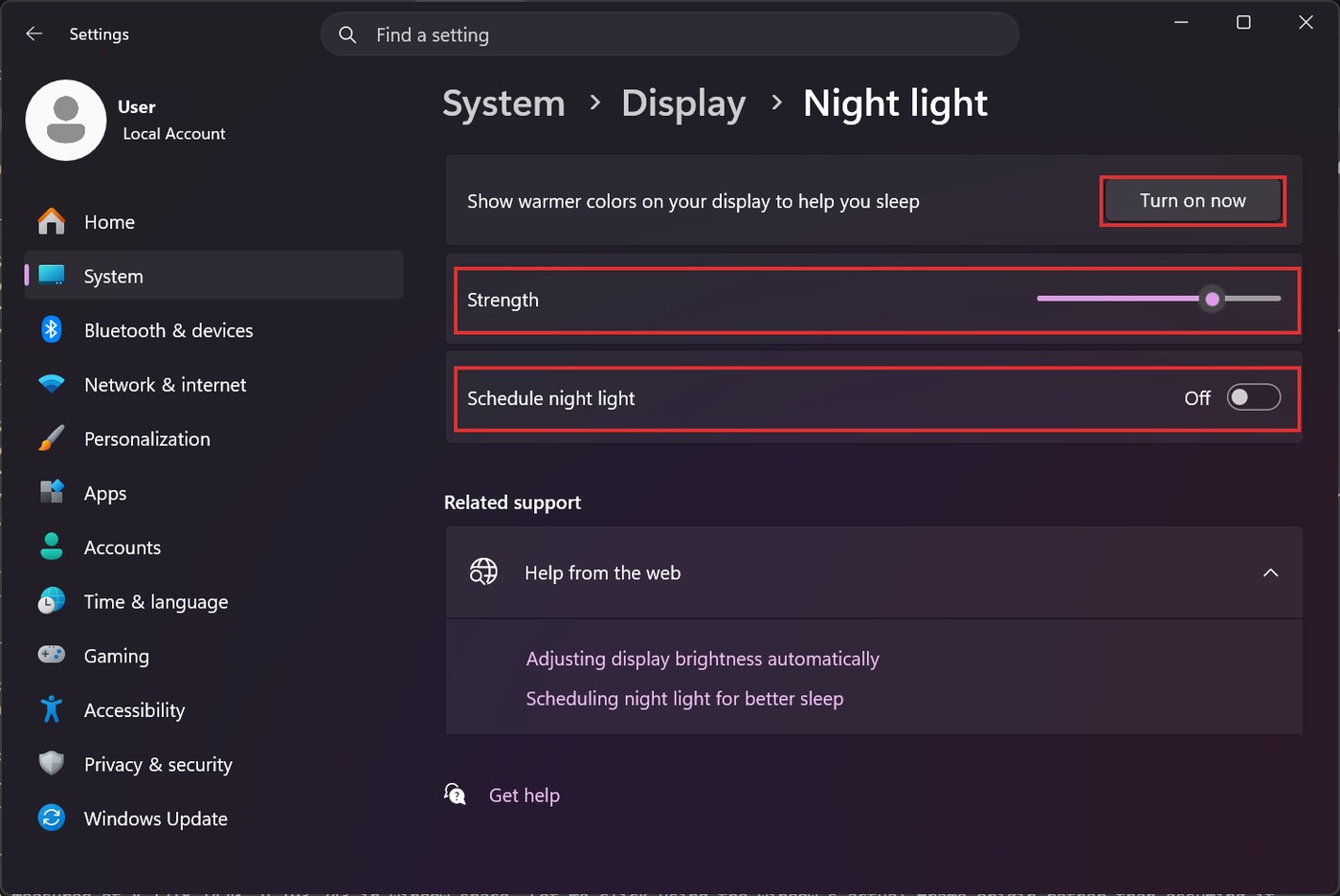
That opens the Night light page, with a Strength slider. Further right is warmer. There is no correct setting; run it where the screen still looks normal to you after a minute.
- Turn on Schedule night light
Sunset to sunrise needs location access. Set hours lets you type your own start and end times instead, which is the option to use if you would rather not turn location services on.
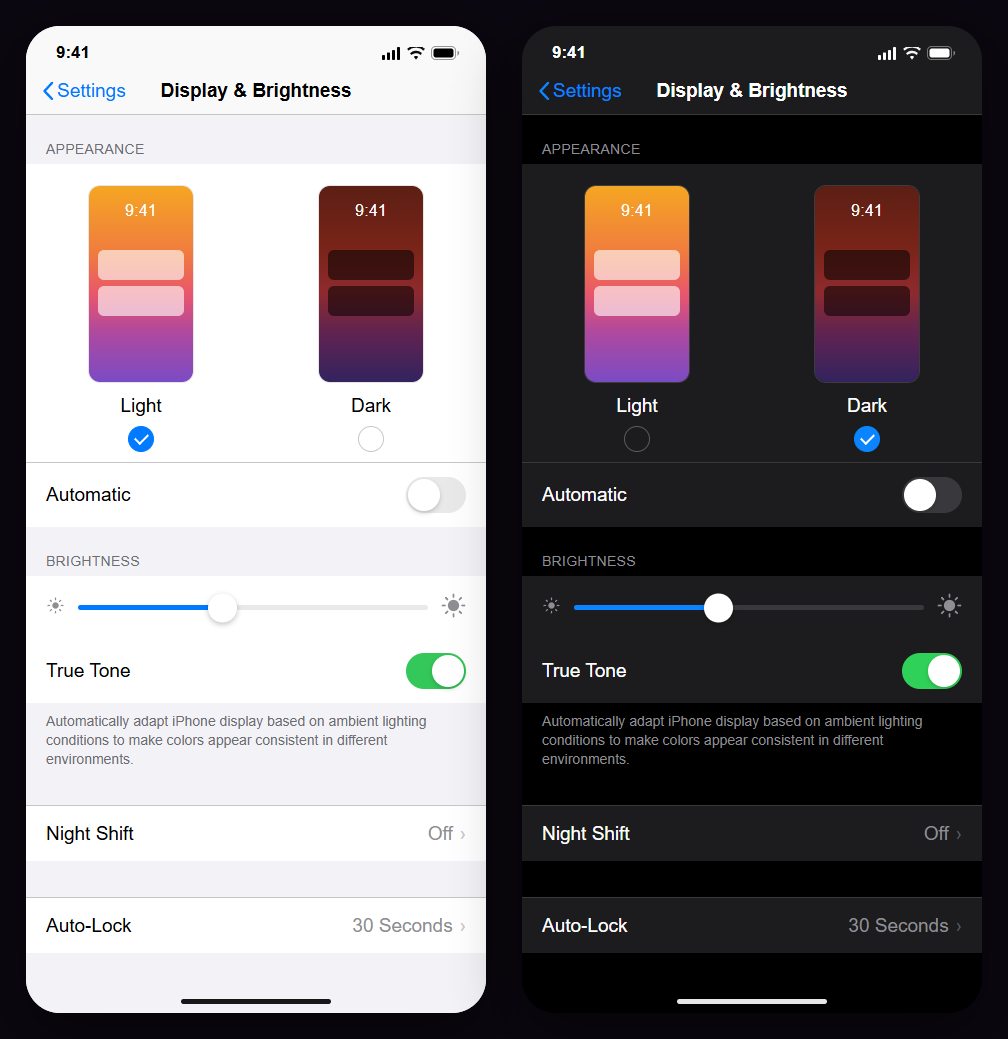
On an iPhone the same control is Night Shift, at Settings › Display & Brightness › Night Shift. Note that it sits on the same screen as the Light and Dark appearance switch while doing a completely different job, which is most of the reason these two get confused.
The measurement that undercuts the whole idea
Here is where it comes apart. In 2019 a team at the Lighting Research Center tested Night Shift directly: does it actually reduce melatonin suppression? They ran participants through four evening conditions, including two Night Shift settings on an iPad, one cool and one warm.
The cool setting measured 5997 K and about 98 lux at the eye, and suppressed melatonin 19 percent after two hours. The warm setting measured 2837 K and about 54 lux, and suppressed it 12 percent. The difference was not statistically significant (Lighting Research & Technology). The authors' conclusion is worth quoting as written: changing the spectral composition of self-luminous displays without changing their brightness settings "may be insufficient for preventing impacts on melatonin suppression."
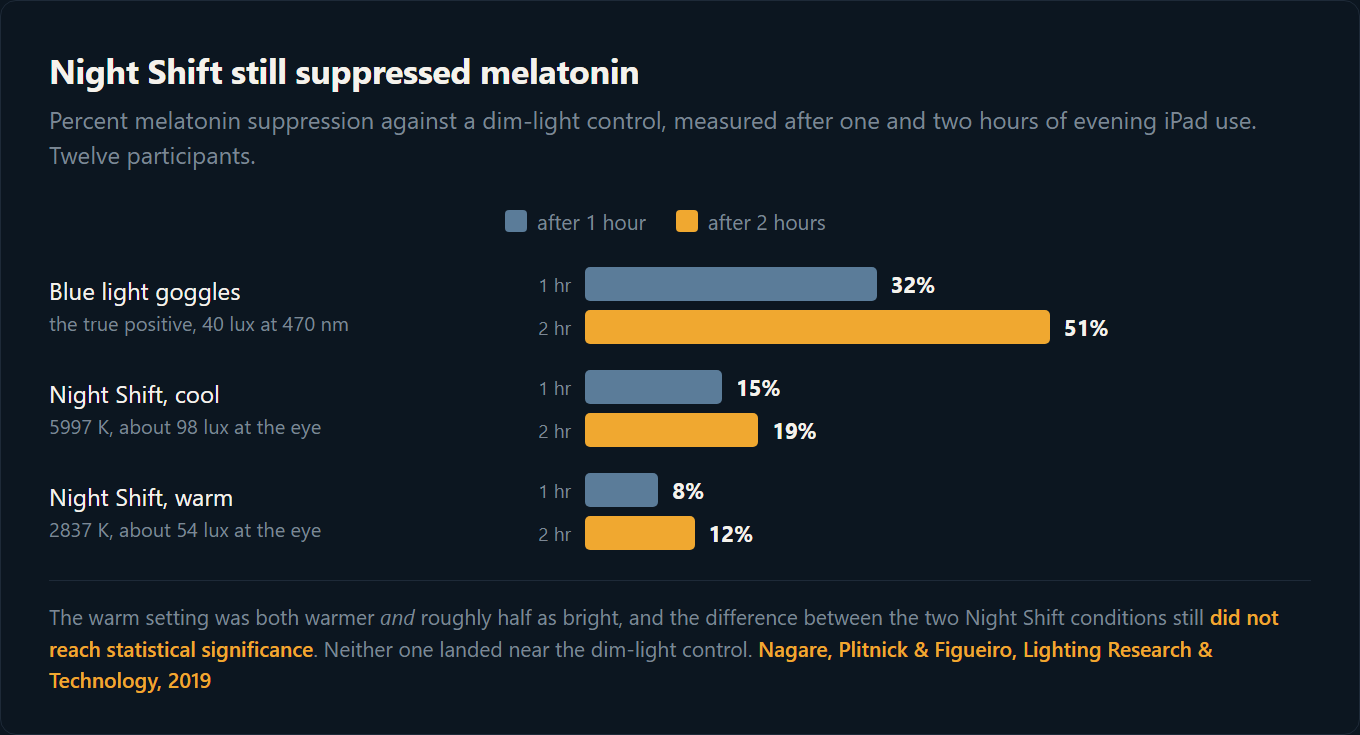
Two things deserve honesty here. This was 12 participants, which is small, and the warm condition was not only warmer but roughly half as bright, which should have helped it. It still did not separate. A study this size cannot rule out a modest benefit, but it is the study that set out to find one, and it did not.
Warm looking is not the same as circadian quiet
There is a deeper problem with judging a screen by its color temperature. A 2018 study at Philips Lighting Research showed that you can hold illuminance and color temperature constant, tune only the shape of the spectrum, and strongly change how much melatonin is suppressed (Journal of Biological Rhythms).
Which means color temperature is a poor proxy for circadian effect. Two screens can look identically warm and do measurably different things to your melatonin. "Warmer" is a description of how light looks to you, not of what it does to the receptor.
Then somebody tested it for a week in real life
The laboratory question is whether the setting changes melatonin. The practical question is whether it changes your sleep. In 2021, Duraccio and colleagues at Brigham Young University ran the trial that asks the second one.
167 adults aged 18 to 24 were randomly assigned to one of three conditions for seven consecutive nights: iPhone use in the hour before bed with Night Shift on, the same with Night Shift off, and no phone at all. Sleep was measured with wrist-worn accelerometers rather than by asking people how they slept. The result: no significant differences in sleep outcomes across the three groups (Sleep Health).
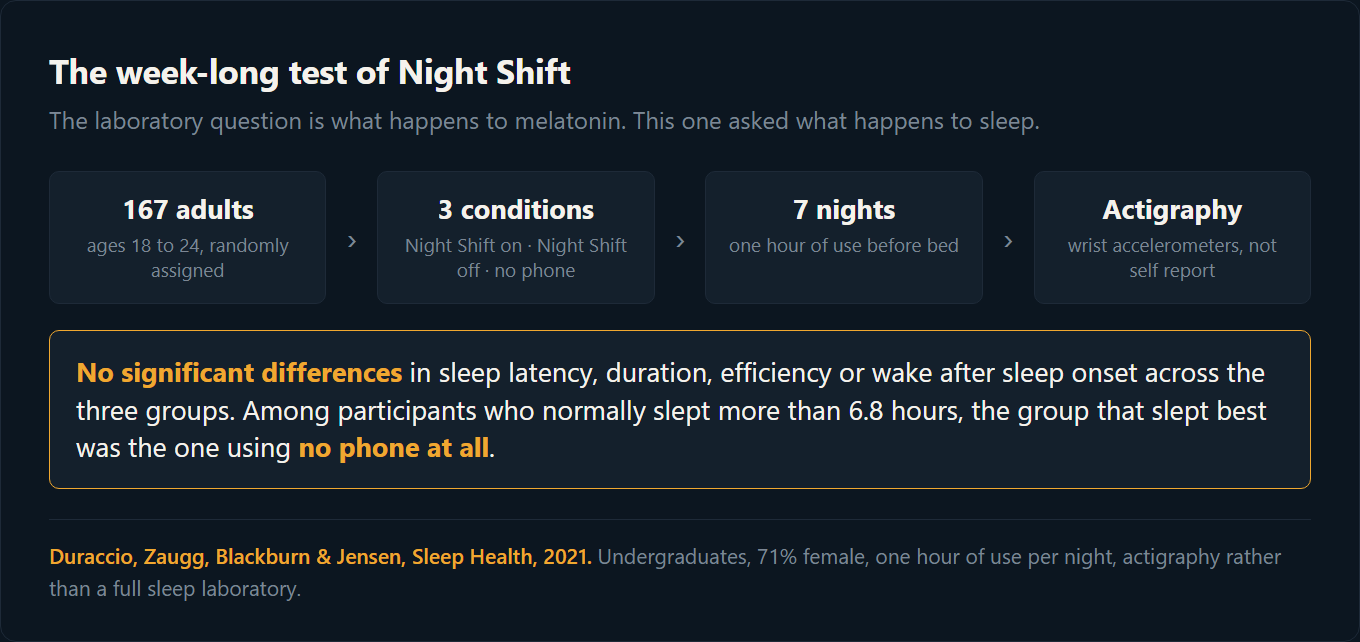
The follow-up analysis is the interesting part. Among participants who normally slept more than 6.8 hours a night, condition did matter for sleep efficiency and time awake after falling asleep, and the group that did best was the one using no phone. Not the Night Shift group. Among the people already short on sleep, nothing mattered, which likely means sleep pressure overwhelmed everything else.
The authors' reading is that the problem is not only light. A phone keeps you mentally engaged, and that arousal does not care what color the screen is. It is worth noting what this trial is and is not: undergraduates, mostly women, one hour of use, actigraphy rather than a full sleep lab. But it is the closest thing to a real-world test that exists, and its answer is no.
What about red light?
The premise behind Night light is sound as far as it goes. Long wavelengths really are gentler on the clock, and the difference is large when you measure it properly.
Wright and Lack put 15 volunteers through five wavelengths of LED light, all equated for irradiance so that only the color varied, from midnight to 2 am. The short wavelengths, 470, 497 and 525 nm, suppressed melatonin by 65 to 81 percent and delayed melatonin timing the following night by 27 to 36 minutes. Red at 660 nm and amber at 595 nm did significantly less on both measures (Chronobiology International).
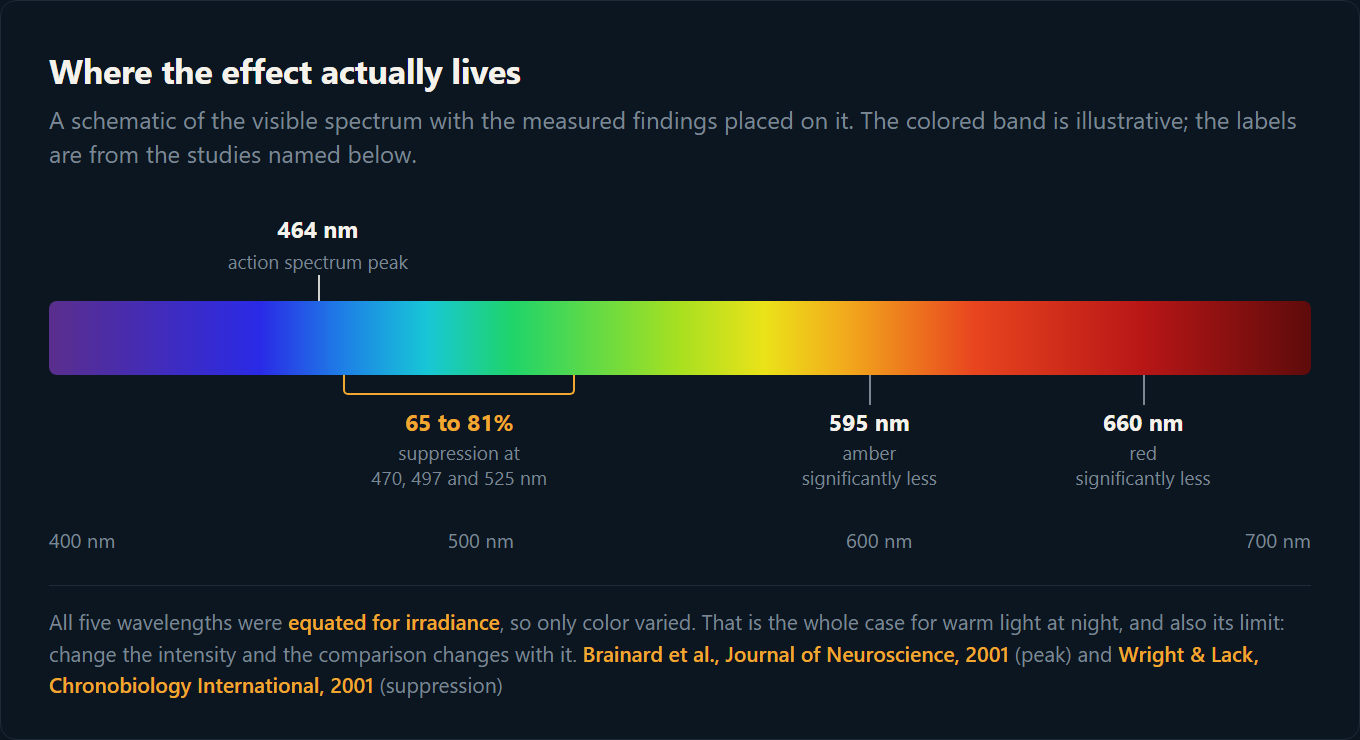
So at matched intensity, red is dramatically weaker than blue. That is the genuine case for a red bulb in a hallway at night, and it is why the color of the light in your room is a reasonable thing to think about.
What it is not is a free pass, and the reason is in the word intensity. Those wavelengths were equated deliberately, because the effect depends on how many photons reach your eye as much as on their color. A dim red lamp across the room and a bright orange screen 14 inches from your face are not the same exposure, whatever the color temperature says. Distance and brightness are doing more work than hue.
Meanwhile, the light you are ignoring
While everyone argues about phones, there is usually a much larger light source in the room.
Gooley and colleagues compared 116 people living under ordinary room light, below 200 lux, against dim light in the hours before bed. Room light delayed the onset of melatonin in 99 percent of participants and shortened melatonin duration by about 90 minutes (Journal of Clinical Endocrinology & Metabolism). Light at that same everyday level during the usual hours of sleep suppressed melatonin by more than half in 85 percent of trials.
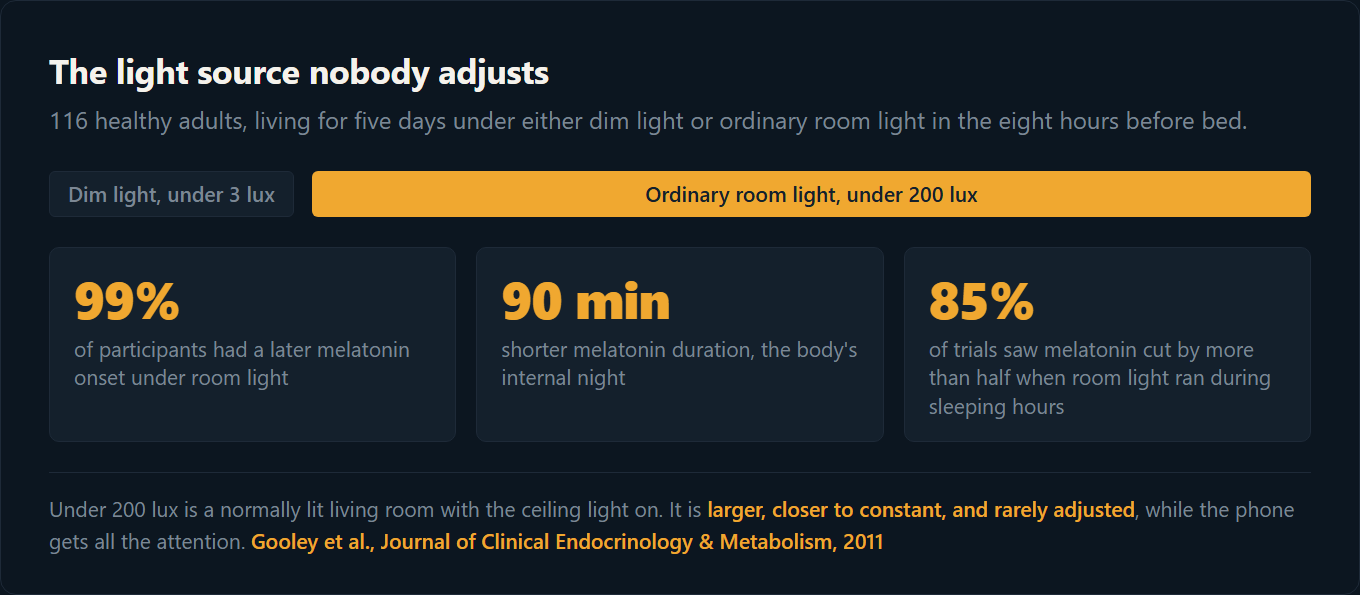
Under 200 lux is not a bright room. That is a normally lit living room with the ceiling light on. It is bigger than your phone, it is on for longer, and almost nobody thinks about it while carefully setting the color temperature of a six-inch screen.
While we are here: blue light glasses
Same category of claim, so it is worth settling. A 2023 Cochrane review pooled 17 randomized trials covering 619 people and found blue-light filtering lenses probably make no difference to eye strain, visual performance or sleep quality.
A 2025 meta-analysis went after sleep specifically, pooling three double-blind crossover trials that measured sleep with wrist actigraphy rather than questionnaires. Across 49 participants it found no significant effect on any outcome (Frontiers in Neurology): sleep onset latency 4.9 minutes shorter with a confidence interval running from 20 minutes better to 10 minutes worse, total sleep time 8.8 minutes longer with an interval from 35 minutes worse to 53 minutes better, and sleep efficiency and time awake essentially unchanged. The authors' phrasing is that the glasses may offer small improvements but the evidence does not support significant effects.
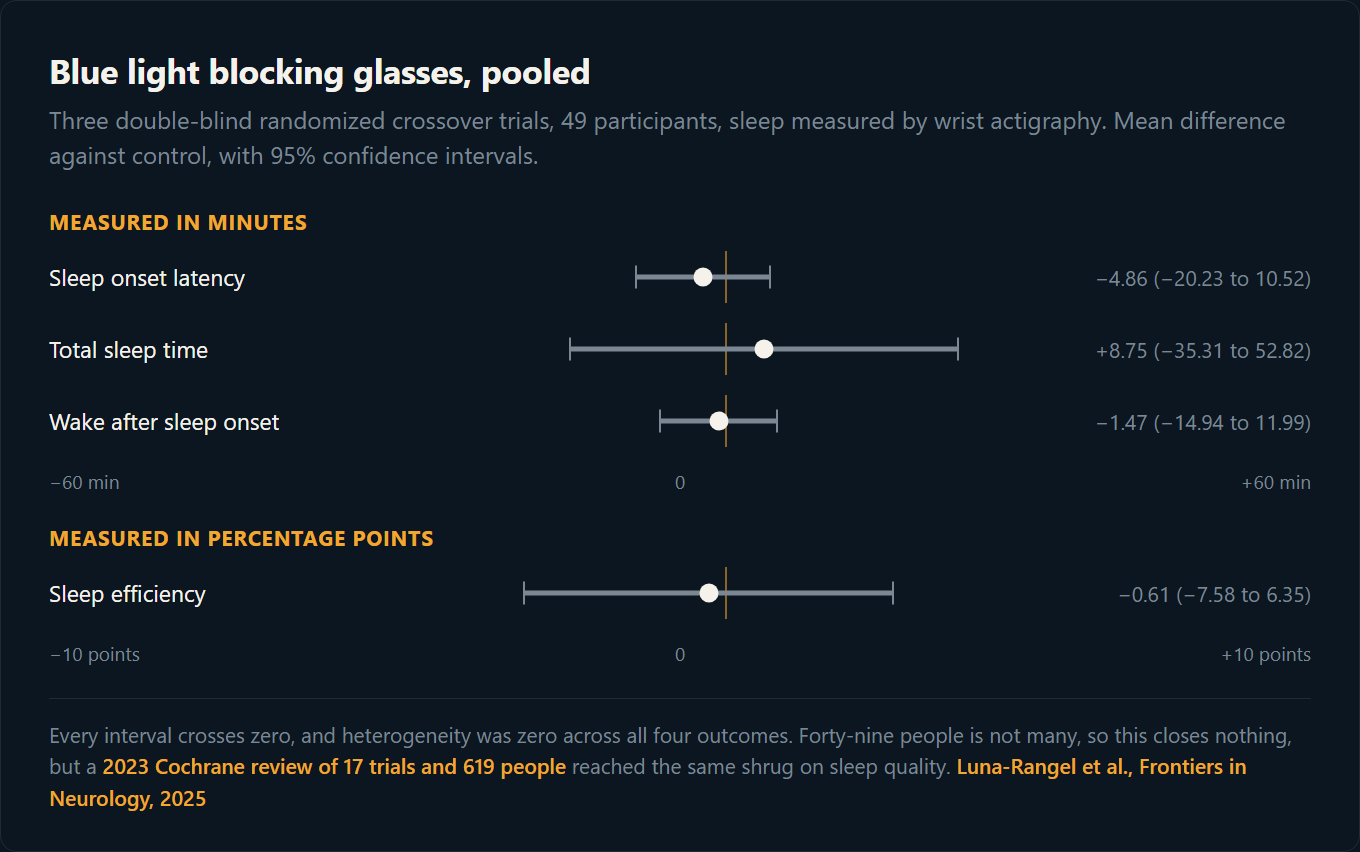
Forty-nine people is not many, so this is not a closed case. But two independent syntheses landing on the same shrug is a reasonable basis for not spending money.
| Claim | What the evidence says | Source |
|---|---|---|
| Blue light suppresses melatonin | Yes. A non-rod, non-cone receptor system peaks in the blue, around 464 nm | J Neuroscience 2001; J Physiology 2001 |
| Evening screens delay your body clock | Yes, at a heavy dose. Four hours of e-reading pushed melatonin onset more than 1.5 hours later and cut REM sleep. Twelve people, in a lab | PNAS 2015 |
| Red light is gentler than blue | Yes, at matched intensity. 470 to 525 nm suppressed melatonin 65 to 81 percent; 660 nm red did significantly less | Chronobiology International 2001 |
| Night Shift reduces melatonin suppression | Not shown. Warm and cool settings did not differ significantly, and both still suppressed melatonin | Lighting Research & Technology 2019 |
| Night Shift improves your sleep | Not shown. 167 adults, seven nights: no difference between on, off and no phone | Sleep Health 2021 |
| A warmer screen means a safer screen | No. Melatonin suppression can be cut sharply at identical brightness and color temperature, so color temperature is a poor proxy | J Biological Rhythms 2018 |
| Your phone is the main problem | Often not. Ordinary room light under 200 lux delayed melatonin onset in 99 percent of people | J Clinical Endocrinology & Metabolism 2011 |
| Blue light glasses improve sleep | Probably no difference, on two separate syntheses | Cochrane 2023; Frontiers in Neurology 2025 |
| Putting the device down helps | The only recommendation the eye doctors actually make, and the no-phone group slept best in the one week-long trial | AAO; Sleep Health 2021 |
So what actually works in the evening
Everything above points the same direction, and none of it is a setting you toggle once.
Turn the brightness down, not just the temperature
This is the variable Night Shift by itself does not change, and the one the 2019 study singled out. Screen brightness on both Windows and iOS is a slider you already know where to find. It costs nothing to run your screen dimmer at night, and unlike color temperature, it is the lever the evidence keeps pointing at.
Turn the room down too
Given that under 200 lux was enough to delay melatonin in 99 percent of people, the ceiling light is worth more attention than the phone. One dim, warm lamp instead of overheads in the last hour is a bigger change than anything in Settings.
Stop earlier, rather than filtering longer
The AAO's guidance is to put the device down one to two hours before bed. In the trial that tested the alternative for a week, the group that used no phone slept better than the group that used one with Night Shift on. Warming the screen is not a substitute for stopping.
Remember the part that is not light at all
The Sleep Health authors were explicit about it: a phone keeps you engaged, and mental arousal does not care about color temperature. A calm hour on a bright screen may well beat an anxious hour on an orange one. No display setting has ever addressed this, and it may be the larger effect.
And get light in the morning
The same receptor that makes evening light a problem makes morning light useful. The circadian system responds to light by time of day, which is why the wavelength studies measured phase advances from morning exposure and phase delays from evening exposure. Daylight early is the other half of the same mechanism, and it is free.
SHOULD YOU TURN NIGHT LIGHT ON ANYWAY?
Sure, if you like it. A warmer screen at night is genuinely more comfortable to look at in a dim room, and that is a perfectly good reason on its own. The mistake is treating it as a sleep intervention and stopping there, because then it displaces the things that do work: less light, less time, and an earlier finish.
The short version
Blue light suppresses melatonin. Screens at night can delay your body clock. Both true. But the feature sold as the fix for that has been tested twice, once on melatonin in a lab and once on sleep across a week, and it did not clearly do anything either time.
What is left is duller and more effective: dimmer screen, dimmer room, and an earlier finish. If you want the setting because the orange looks nicer at midnight, that is reason enough. It just is not the reason on the box.
If your question was really about eye strain rather than sleep, the answer there is different and just as counterintuitive, and it is on our guide to dark mode in Windows 11.
This is a summary of published research, not medical advice. If your sleep is a persistent problem, that is a conversation for a doctor rather than a display setting.